The divine form of Lord Hanuman changes three times daily — reflecting the stages of human life. Check the current manifestation and upcoming Aarti timings.
Afternoon (12:00 PM – 4:00 PM)
A strong, focused, and determined expression reflecting discipline, power, and ascetic resolve. Represents absolute self-control, mental focus, physical strength, and complete dedication to service.
Aarti schedule auto-updates based on the time of day.
05:00 AM
Offered at dawn with fresh milk, yogurt, and honey; focuses on awakening the day with pure intentions.
08:30 AM
The deity is adorned with fresh marigolds and silver ornaments while the Hanuman Chalisa is chanted.
12:00 PM
Traditional offerings of pure ghee sweets, primarily the signature Besan Laddus.
07:00 PM
Evening lamp offering accompanied by heavy brass bells, drums, and choral singing.
09:30 PM
Peaceful evening prayers marking the transition to rest and inviting calm.
On Tuesdays & Saturdays, Mangal Aarti begins at 04:00 AM and Shayan Aarti at 11:30 PM.
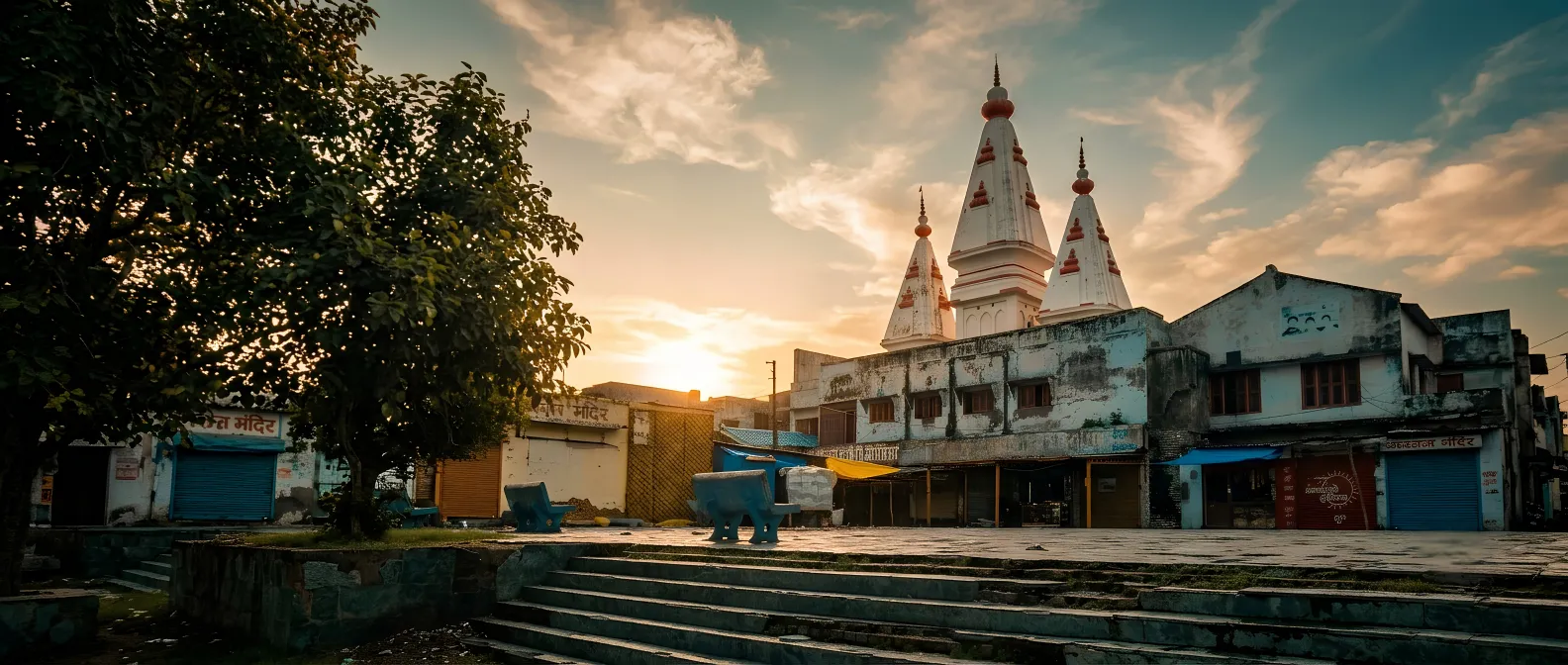
Located on the western outskirts of Kanpur, the ancient shrine of Shri Panki Panchmukhi Hanuman Mandir stands as a timeless sentinel of faith and tradition. Founded over four centuries ago by the revered seer Shri 1008 Mahant Parashostam Das Ji, this sacred sanctuary predates the modern city of Kanpur.
It remains a rare and significant site where the deity is worshipped in his five-faced (Panchmukhi) configuration, showing a unique countenance that changes to reflect the stages of human life as the day progresses. Blessed by the modern spiritual presence of Neem Karoli Baba, Panki Mandir continues to be a vibrant center of pilgrimage, service, and deep devotion.
Visitor Hours: Open daily from 05:00 AM to 12:00 PM and 02:00 PM to 10:00 PM. Open continuously on Tuesdays from 04:00 AM to midnight.
Discover the four pillars that make Panki Hanuman Mandir one of the most sacred and unique temples in North India.
The origins of Panki Mandir trace back to a divine revelation granted to Shri 1008 Mahant Parashostam Das Ji during his return from Chitrakoot. Deep within a dense forest, the sage discovered a massive, self-manifested rock bearing the likeness of Lord Hanuman — the central focal point of the inner sanctum.
The temple is highly revered for housing Lord Hanuman in his rare five-faced (Panchmukhi) form — Hanuman (courage), Narasimha (protection), Garuda (warding off toxic energy), Varaha (strength), and Hayagriva (wisdom) — together offering complete spiritual protection.
In January 1964, the spiritual profile of Panki Mandir was enriched by its connection to the modern saint Neem Karoli Baba, who guided a major expansion of the complex. The consecration ceremony on January 21, 1964, remains legendary for documented miracles of food multiplication during the community feast.
Panki Mandir is the cultural heart of Kanpur during the historic celebrations of Budhwa Mangal (Bada Mangal), observed on the Tuesdays of Jyeshtha. The temple draws hundreds of thousands of pilgrims, hosting massive Bhandaras (community feasts) distributing sacred food to all.
From divine origins to the present day — the sacred history of Panki Dham.
Returning from his spiritual retreat in Chitrakoot, the saint Shri 1008 Mahant Parashostam Das Ji discovers the self-manifested (Swayambhu) rock in a dense forest, establishing a simple thatch-roofed shrine before the development of modern Kanpur.
As the shrine's reputation grows, an attempt to move the heavy stone closer to the Ganges at Bithoor fails when the cart breaks down — confirming the deity's wish to remain in Panki and leading to the construction of the permanent stone sanctum.
Under the guidance of Neem Karoli Baba and his devotee Devkamta Dixit, a new marble idol of Hanuman is consecrated on January 21, 1964, accompanied by legendary miracles of food multiplication during the community feast, cementing the temple's place on the national pilgrimage map.
The temple is integrated into modern regional infrastructure, highlighted by the redeveloped Panki Dham Railway Station under the Amrit Bharat Station Scheme, featuring temple-themed architecture and traditional murals. Over 15,000 devotees visit daily.
Join the Shri Panki Dham Digital Sangha. Follow us for daily blessings, live aartis, and spiritual content.
@panki__dham__ on Instagram
Follow the official Instagram page for daily darshan, aarti live streams, festival celebrations, and spiritual content from Panki Panchmukhi Hanuman Mandir.
Everything you need for a blessed and well-coordinated visit to Panki Hanuman Mandir.
Regular Days: 05:00 AM – 12:00 PM & 02:00 PM – 10:00 PM
Tuesdays & Saturdays: 04:00 AM – 12:00 AM (Midnight)
Open continuously on Tuesdays for the massive devotee crowds.
Modest Attire: Traditional Indian attire is highly recommended. Men are encouraged to wear dhotis, kurtas, or full-length trousers; women are advised to wear sarees or salwar suits. Please avoid wearing shorts, short skirts, or sleeveless tops.
October to February: The cooler winter months offer the most comfortable weather for travel. Visiting during late morning on weekdays is ideal to avoid long lines.
By Rail: Panki Dham Station (1 km away) for local trains; Kanpur Central (13 km) for long-distance.
By Air: Kanpur Airport (KNU) is 25 km away; Lucknow Airport (LKO) is 90 km away.
By Taxi: Ride-sharing services available; city center drive takes 30–45 minutes.
Free parking for two-wheelers and passenger vehicles is available near the western entrance. The Kanpur Development Authority (KDA) is also developing a new 4-acre parking facility near the eastern gate.
Photography is permitted in the outer courtyards and gardens for personal memories. However, photography is strictly prohibited inside the inner sanctum (Garbhagriha) to preserve the sacred atmosphere.
Temple on Social Media
Stay connected with daily blessings, live aarti broadcasts, and spiritual content from Panki Dham.
Instagram Reels
@panki__dham__
YouTube
PankiMandirOfficial
Shorts